the ODD COUPLE (1968)
keeping teams functional
New York in the late 1960’s is a city of noise, motion, and cramped living — a place where space is limited and personalities have nowhere to hide. In a Manhattan apartment high above the street, two men with opposite instincts collide under one roof. Recently divorced Felix Ungar arrives with his rituals, his precision, and his belief that order creates safety. Oscar Madison counters with looseness, humor, and the survival strategy of a man who has learned to roll with the punches. Oscar allows Felix to stay out of kindness for this friend, but the tides soon turn. Their apartment becomes a laboratory for human behavior under the friction of two disparate worldviews forced into daily contact.
The Odd Couple is a comedy on the surface, but underneath the humor is a sharp study in how two people with opposite temperaments shape, challenge, and develop each other. Felix Ungar and Oscar Madison aren’t just mismatched roommates; they are two leadership styles forced into one environment. Their dynamic becomes a case study in how people grow through friction, how blind spots get exposed in close quarters, and how leadership often emerges from the tension between two extremes.
Leadership Lesson
Leadership development often happens through contrast, not similarity. When two people with opposing instincts share responsibility, each becomes a mirror for the other’s blind spots. Felix and Oscar show that growth comes from friction, accountability, and the willingness to adjust your emotional temperature when the environment demands it.
What makes Felix and Oscar compelling is that neither man is fully right or fully wrong. Their leadership styles are incomplete on their own, but transformative when forced into dialogue. The apartment becomes a training ground where each man’s habits, instincts, and emotional defaults are exposed under pressure. Growth doesn’t come from harmony. It comes from the willingness to stay in the room, to absorb discomfort, and to let someone else’s strengths challenge your own shortcomings.
CASE STUDY 1: FELIX UNGAR
Character Psyche
Felix is a man who believes order creates safety. His leadership instinct is to stabilize the environment through structure: clean spaces, clear expectations, routines, and emotional honesty. Underneath the fussiness is a man who feels deeply and expresses it immediately, sometimes hastily. His strength is clarity; his weakness is intensity. Felix teaches through standards, through the belief that people rise when expectations rise. But he also exposes the risk of over‑managing; structure becomes suffocation, when people shut down instead of stepping up.
Felix’s precision is not just preference, it’s protection. His rituals are a way of managing anxiety in a world that feels too chaotic, too fast, too indifferent to the details he believes matter. His leadership instinct is to create clarity where he feels vulnerability. But clarity without pacing becomes pressure. Felix must learn that leadership is not only about raising standards, but about understanding when the environment, or the person across from him, needs space instead of structure.
NYC Reality Check
1968 New York is cramped, loud, and unpredictable; the exact opposite of Felix’s internal wiring. The city constantly disrupts his need for control, forcing him to confront the limits of perfectionism in an environment that doesn’t care about his rules.
Why It Still Matters
Modern teams often include “Felix types”: detail‑driven, emotionally expressive, high‑standard operators who elevate the work but can overwhelm the room. Felix shows that structure is valuable, but only when paired with empathy, pacing, and the ability to read the emotional temperature of others.
Teaching Points
Standards elevate performance. Felix raises the bar simply by expecting more.
Emotional honesty builds clarity. He says what others avoid, which cuts through noise.
Over‑control creates resistance. His intensity pushes Oscar away instead of pulling him forward.
Leadership requires calibration. High standards must be matched with emotional awareness.
Structure is a tool, not a personality. When Felix learns to soften, people respond better.
CASE STUDY 2: OSCAR MADISON
Character Psyche
Oscar leads through comfort, humor, and adaptability. He is the emotional buffer in the room; the person who absorbs tension, defuses conflict, and keeps things moving. His strength is flexibility. His weakness is avoidance. Oscar’s instinct is to keep the peace, even if it means letting standards slip. He teaches through presence and ease, but he also reveals the danger of under‑leading: when flexibility becomes neglect, people lose trust and the environment deteriorates.
Oscar’s looseness is both charm and shield. He uses humor to deflect discomfort and flexibility to avoid conflict, convincing himself that ease is the same as harmony. But beneath the jokes is a man who knows he’s falling short of his own potential. His leadership arc is about confronting the cost of avoidance: the missed commitments, the emotional debris, the quiet erosion of trust. He ultimately learns that responsibility is not a burden, but a form of respect.
NYC Reality Check
Oscar’s New York is a place where improvisation is survival. The city rewards his looseness and humor, but it also exposes the consequences of his lack of structure: missed commitments, broken systems, and emotional messes that someone else must clean up.
Why It Still Matters
Many leaders today default to Oscar’s style: relaxed, likable, and conflict‑averse. Oscar shows that flexibility is valuable, but only when paired with accountability. Without it, teams drift, standards fall, and relationships strain.
Teaching Points
Flexibility reduces friction. Oscar keeps situations from escalating.
Ease builds rapport. People trust leaders who feel human and approachable.
Avoidance creates instability. His reluctance to confront issues makes problems worse.
Responsibility is non‑negotiable. Leadership requires follow‑through, not just good intentions.
Balance beats extremes. Oscar grows when he adopts some of Felix’s structure.
THE TEACHER–STUDENT DYNAMIC: HOW FELIX AND OSCAR BUILD EACH OTHER
Felix and Oscar are not opposites. They are two halves of a complete leader. Felix teaches Oscar discipline, responsibility, and the value of standards. Oscar teaches Felix ease, flexibility, and the value of emotional pacing. Their growth comes from the collision of two leadership instincts that, when combined, create balance.
Their partnership works because each man carries what the other lacks. Felix brings standards that force Oscar to grow up. Oscar brings warmth that teaches Felix to breathe. Together they form a complete emotional system: structure and ease, precision and flexibility, honesty and patience. Their conflicts are not failures; they are the curriculum. And by the end, each man walks away with a more balanced version of himself, shaped not by agreement, but by the courage to stay in the friction long enough to learn.

Oscar Madison’s apartment was at 131 Riverside Drive
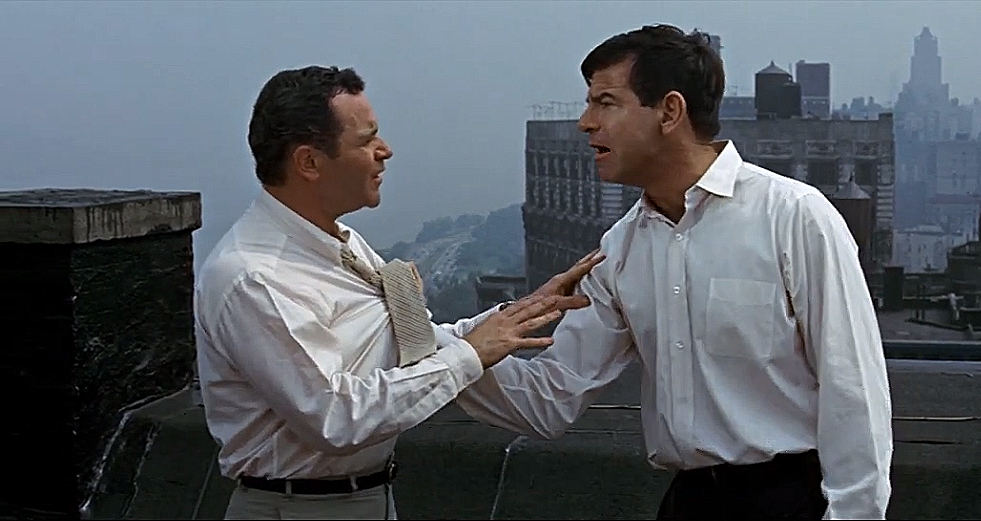
Oscar and Felix reach a breaking point on the rooftop, each convinced the other is the obstacle they can’t escape.